
This article focuses on the Best Online Business Bank Accounts for Small Businesses that provide ease of mind in financial management at a lower cost while supporting growth. Small businesses require banking partners that provide pricing with no surprises, fast transactions, and integrations with accounting or payment systems. The firms Qonto, Airwallex, Payoneer, Novo, Starling Bank Business, RazorpayX, Mercury, Brex, Wise Business, and Revolut Business excel among others in meeting the varying needs of small businesses. Features such as transaction management, operation scaling, and the ease of international business are just a few examples of what these firms provide.
Benefits Of Online Business Bank Accounts for Small Companies
Lower Banking Fees: Because online business accounts typically charge less for banking services, it is possible to find accounts or services that eliminate or reduce most each of the following fees: minimum balance, transaction, monthly account maintenance, and other fees.
Faster Account Opening: Small companies can quickly open accounts by completing digital applications which automate business information submissions, verification, and other processes which traditionally require a branch visit.
24/7 Access to Your Account: Owners can manage their accounts at any time by viewing account activity, transferring funds, and viewing balances and account transactions.

Tools for Expense Managment: Digital banking can categorize transactions, provide spending and expense insights, and offer product integrations within banking systems which include company spending cards and expenses that can be captured using digital receipt technologies.
Administration of Digital Payments: Businesses can manage electronic payment transactions and related banking processes for payments and invoicing without reliance on other banking systems and processes.
Integration with Accounting Systems: Online business banking systems can integrate with accounting systems used by companies which provides a simplified interface for bookkeeping.
Immediate Insights into Cash Flow: Digital dashboards can provide real-time balances, and information on recent transactions and payments.
Improved Employee Expense Management: Systems can be used to manage the expense of employees by providing cards with purchasing control and expense limits that can be managed by approving transactions and providing notifications.
Support for International Banking: Accounts can be used to support banking that requires transacting in multiple currencies and includes transferring funds to and from different countries.
Key Points
- Qonto: Best for European small businesses needing digital banking, expense management, invoicing, and accounting integrations.
- Airwallex: Best for globally active companies needing multi-currency accounts, international payments, corporate cards, and expense management.
- Payoneer: Best for freelancers, e-commerce sellers, and SMBs receiving and sending international payments across global markets.
- Novo: Best for U.S. small businesses seeking simple online business checking with low-fee banking and integrations.
- Starling Bank Business: Best for UK small businesses wanting mobile-first banking, accounting integrations, and straightforward business account management.
- RazorpayX: Best for Indian businesses needing business banking, automated payouts, payroll, vendor payments, corporate cards, and APIs.
- Mercury: Best for U.S. startups and small companies seeking online banking, payments, treasury tools, and startup-focused financial management.
- Brex: Best for startups and growing companies needing corporate cards, expense controls, travel management, and spend automation.
- Wise Business: Best for small companies making frequent international payments with transparent multi-currency transfers and local account details.
- Revolut Business: Best for companies managing global payments, multiple currencies, team spending, payroll, and accounting integrations.
10 Best Online Business Bank Accounts for Small Companies 2026
1. Qonto
Founded in 2016 in France, Qonto offers banking products for freelancers and small businesses. Qonto offers services tailored to freelancers starting at €9/month and team pricing starting at €39 per user.
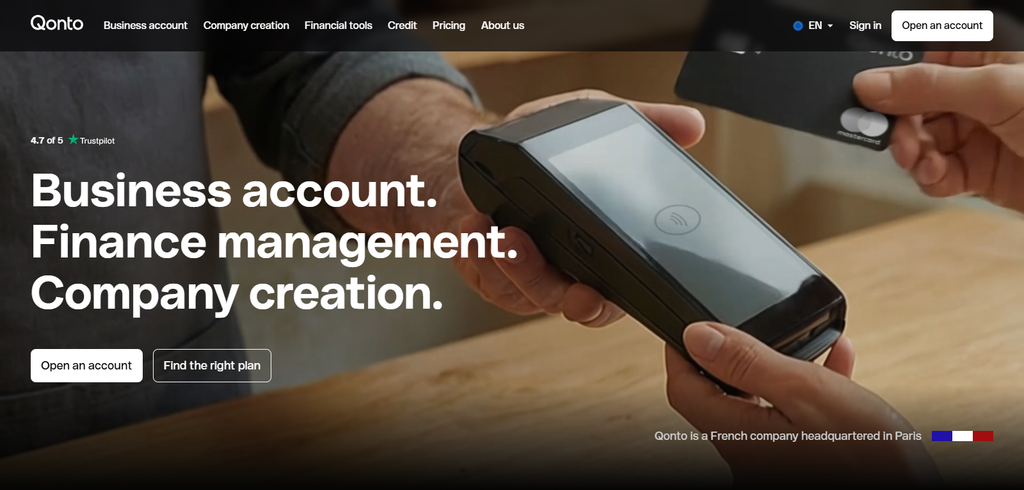
Qonto offers local payment methods, IBAN, and card issuances. Qonto has a fast settlement time of 1-2 business days, and has a dashboard to manage chargebacks.
Qonto earns points for strong business support and integration with accounting and expense tracking applications. The strongest indicator of Qonto’s product is predictability. Qonto charges set, predictable, monthly fees, which is attractive for startups and SMEs.
Qonto Details
- Year of founding: 2016 (France)
- Monthly pricing: €9 – €39+ (transparent)
- IBAN accounts for EU businesses
- Expense tracking, accounting software integrations
- Multi‑user access with role management
- Fast SEPA transfers (1–2 days)
- Physical & virtual cards available
- SMEs and freelancers (scale)
| Pros | Cons |
|---|---|
| Transparent monthly pricing | Limited to EU region |
| Strong SME & freelancer focus | No U.S. presence |
| IBAN accounts | FX fees higher than Wise |
| Expense tracking tools | Premium tiers costly |
| Multi‑user role management | Limited global reach |
| Fast SEPA transfers | Not ideal for enterprises |
| Virtual & physical cards | Limited lending options |
| Accounting integrations | Add‑ons increase costs |
2. Airwallex
Airwallex, established in 2015, offers cross border payments. Airwallex charges a margin of 0.3-0.6% over the interbank rate and charges no account fees. Airwallex supports multi-currency accounts and offers competitive settlement times across many regions. Airwallex has local payment methods in 180+ countries.
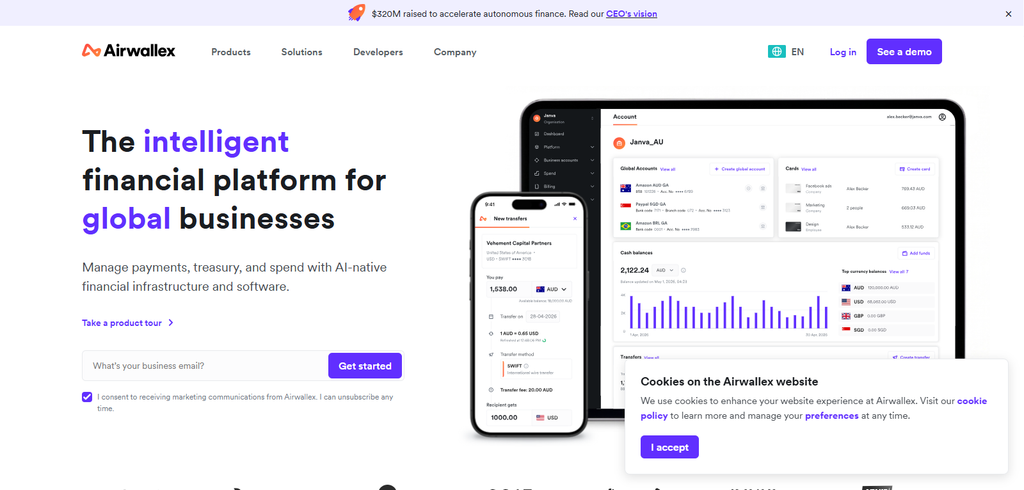
Chargeback management is integrated, and Airwallex has APIs for easy international growth. Airwallex supports domestic and international businesses with a competitive trade platform that manages cross border payments. Airwallex has the technology and services that provide enterprise grade control and support for cross border payments.
Airwallex Details
- Year of founding: 2015 (Melbourne)
- No monthly fees
- FX margin: 0.3 – 0.6% above interbank
- Multi‑currency accounts: 180+ countries
- API integrations for global expansion
- Fast settlement across regions
- Local payment rails
- Scaling infrastructure
| Pros | Cons |
|---|---|
| No monthly fees | FX margin above interbank |
| Supports 180+ countries | Complex for small firms |
| Multi‑currency accounts | Focused on enterprises |
| API integrations | Limited consumer banking |
| Fast settlement | Learning curve for startups |
| Local payment rails | Not ideal for freelancers |
| Enterprise‑grade security | Requires volume for savings |
| Scalable globally | Limited domestic focus |
3. Payoneer
Headquartered in New York in 2005, Payoneer is a leading Cross-Border Payment Service Provider. A $29.95 annual fee is charged for account maintenance, while transaction fees are between 1-3% depending on payment methods.
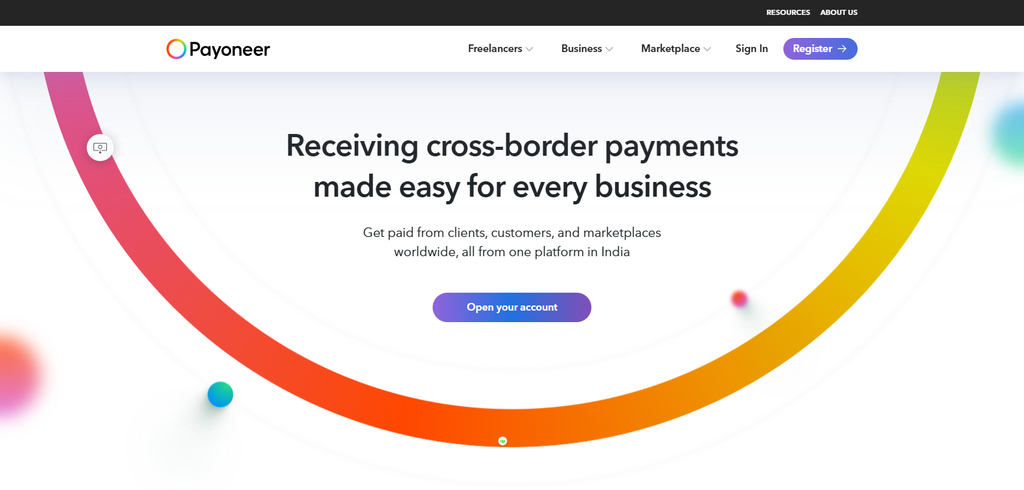
Transactions are usually processed within 24 hours. Payoneer supports over 200 countries’ local payment methods. Payoneer processes chargebacks, although often these services are more relevant to merchants.
Payoneer effectively serves SMEs and freelancers and offers mass payment solutions to marketplace providers. It partners with Amazon, Upwork, and Airbnb, illustrating its strong business support in this area. Reliable payment services bring freelancers and e-commerce sellers to Payoneer.
Payoneer Details
- Year of founding: 2005 (New York)
- $29.95 annual account fee
- Transaction fees: 1 – 3% depending on method
- Payouts in 200+ countries
- Mass Payout Solutions for marketplaces
- Settlement: 24 hours typical
- Chargeback management for merchants
- Trusted by: Amazon, Upwork, Airbnb
| Pros | Cons |
|---|---|
| Global reach (200+ countries) | $29.95 annual fee |
| Quick settlement | Transaction fees 1–3% |
| Mass payout solutions | Chargeback limited |
| Marketplace partnerships | Less domestic focus |
| Trusted by Amazon/Upwork | Higher FX fees |
| Easy freelancer onboarding | Annual fee mandatory |
| Supports multiple currencies | Limited banking features |
| Reliable infrastructure | Not ideal for SMEs scaling |
4. Novo
Established in 2016 in the U.S., Novo, is a digital banking solution for small businesses and startups. Novo’s pricing is simple; they charge no monthly fees, offer free ACH transfers, and reimburse ATM fees. Like most U.S. banks, Novo processes transactions in 1-2 business days. Similar to Payoneer, Novo offers a chargeback solution, but integrates with payment processors.
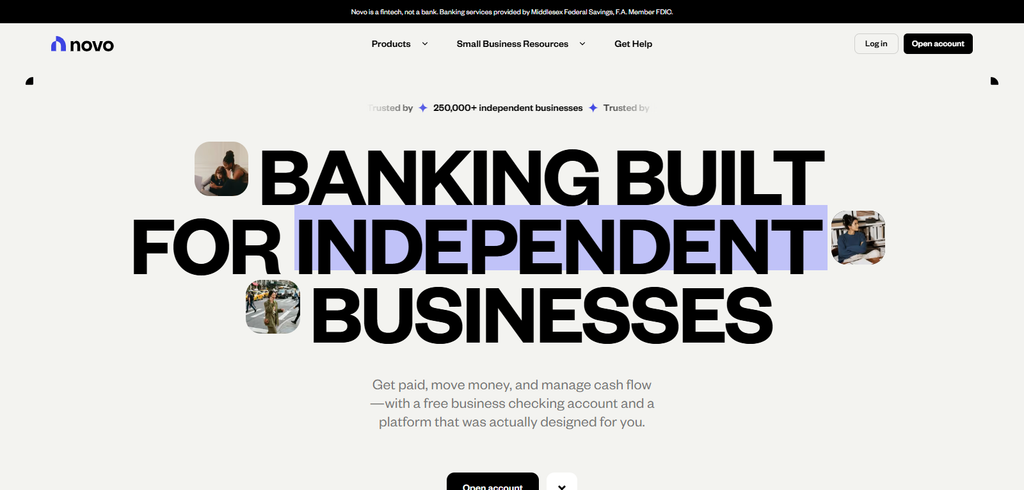
Novo supports business scale through integrations with Stripe, Shopify, and QuickBooks. Local payment methods offered by Novo are U.S. based, making it best suited for domestic startups. Novo offers a simple and transparent banking option that previously was lacking for startups and small businesses. They partner with payment processors to avoid charging customers for their banking services.
Novo Details
- Year of founding: 2016 (U.S.)
- No monthly fees, free ACH transfers
- ATM fee reimbursements in the U.S.
- Stripe, Shopify, QuickBooks integrations
- Local payments in the U.S.
- Standard settlement: 1 – 2 days
- Startup banking made simple
- Expense tracking and budgeting tools
| Pros | Cons |
|---|---|
| No monthly fees | U.S. only |
| Free ACH transfers | No international accounts |
| ATM fee refunds | Limited advanced tools |
| Startup‑friendly integrations | No lending products |
| Simple dashboard | Standard settlement speed |
| Transparent pricing | No FX support |
| Expense tracking | Limited scalability |
| Easy account setup | Not for global firms |
5. Starling Bank Business
Starling Bank Business was established in 2014 in the UK in order to offer convenient digital banking with competitive pricing for UK’s SMEs. Accounts do not have monthly fees, and can include add-ons for bookkeeping for £7 a month. Fast settlement is also offered with the ability to process instant UK Faster Payments and SEPA transfers. Starling Bank Business manages chargeback claims through the services of Mastercard.
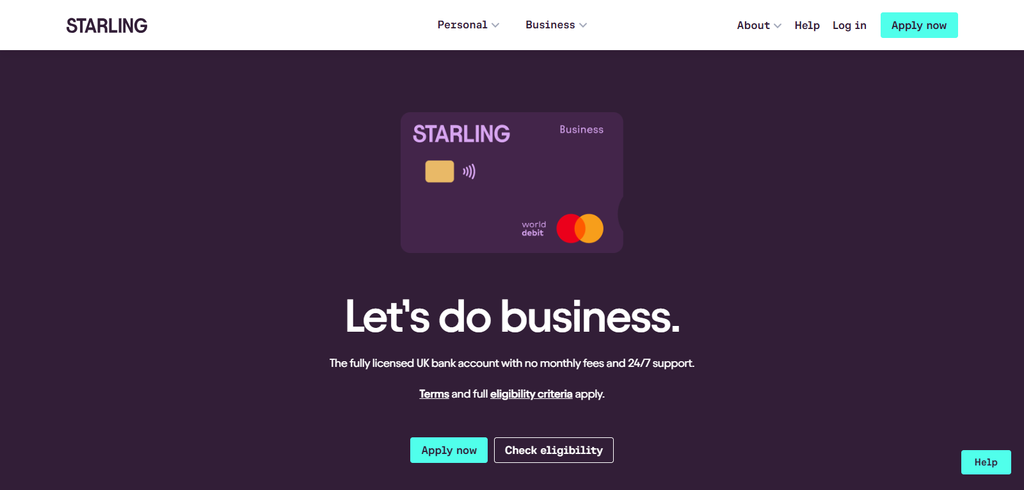
The growth of a business is further supported through marketplace integrations for accounting, payroll, and lending calls. Starling Bank Business supports local payment transfers in the UK and international payment transfers. For UK businesses, the service provides excellent customer service and is easy to scale with a business, making it a top pick for startups and SMEs.
Starling Bank Business Details
- Year of founding: 2014 (UK)
- No monthly account fees
- Add ons: £7 account bookkeeping tools
- Faster Payments/SEPA, instant transfers
- Mastercard chargeback management
- Marketplace integrations such as accounting, payroll
- Local and international payment support
- Best in class customer service
| Pros | Cons |
|---|---|
| No monthly fees | UK‑focused |
| Instant Faster Payments | Limited FX reach |
| Marketplace integrations | Add‑ons cost extra |
| Award‑winning support | Not for large enterprises |
| SEPA transfers | Limited global expansion |
| Mastercard chargeback | No U.S. presence |
| Transparent pricing | Premium features add cost |
| SME scalability | Limited lending options |
6. RazorpayX
Established in 2014 in India, RazorpayX is a neobanking platform built for startups and enterprises. RazorpayX offers pricing with flexible transaction fees of 0.25-0.5% depending on the volume and do not have fixed monthly fees for basic accounts. Rapid settlement is also offered with the ability to process same-day settlements for domestic payments. RazorpayX already offers chargeback management as part of its payment gateway.
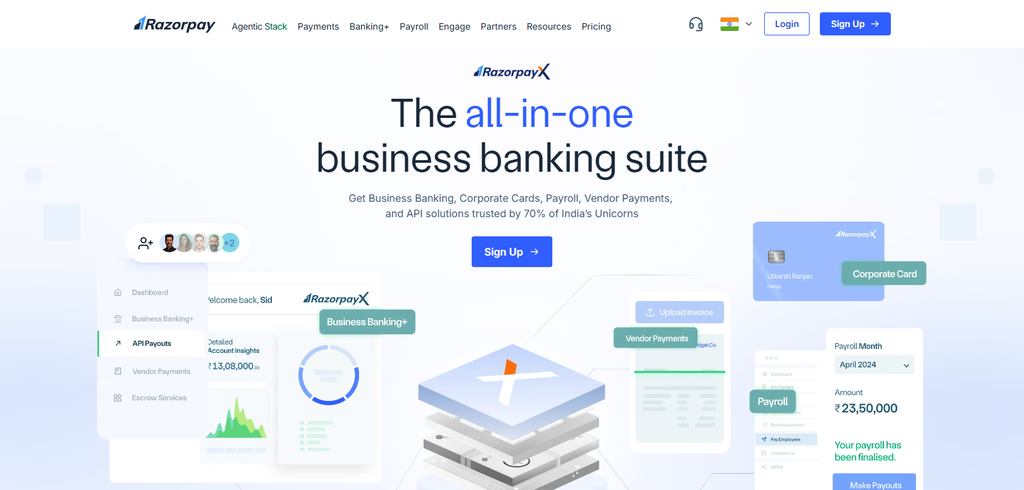
The scalability of business is also well supported with the availability of APIs for payroll and vendor payments and expense cards. Local payment methods include UPI, IMPS, NEFT and RTGS making it a good bank for Indian businesses. RazorpayX is extremely popular among Indian startups for its automation and ability to manage complex financial operations.
RazorpayX Details
- Founded in 2014
- Flexible transaction fees in the range of 0.25% to 0.5%
- Settlement of domestic transactions on the same day
- Integrated with the Razorpay payment gateway
- APIs for payroll and vendor payment automation
- Employee expense cards
- Support for payment rails like UPI, IMPS, NEFT and RTGS
- Automation of workflows of a startup
| Pros | Cons |
|---|---|
| Same‑day settlements | India‑only |
| Supports UPI, NEFT, RTGS | Limited FX services |
| APIs for payroll | Requires Razorpay ecosystem |
| Vendor payment automation | Not global‑ready |
| Expense cards | Limited scalability abroad |
| Startup‑friendly workflows | No lending products |
| Transparent fees | Domestic focus only |
| Strong integrations | FX costs higher |
7. Mercury
In 2019, Mercury launched in the U.S. as a digital bank that focuses on startups. They have low international wire fees, no monthly fees, and free domestic transactions. There is a 1-2 business day settlement that follows the norms of U.S. banks.
Chargeback management is not a focus for Mercury, but they do provide tools for it through payment processor integrations. For business scalability, Mercury offers solutions for venture debt, treasury management, and APIs.
Considering the payment options they offer, Mercury is designed for tech startups. Mercury appeals to the needs of startups in the U.S. for their modern banking and for the focus they give for the growth of the company, also providing transparent pricing and removing barriers related to traditional banking.
Mercury Details
- Started in 2019
- No monthly fees, free transfers
- Low fees for international wires
- Automation tools and payment methods designed for startups in the U.S.
- Venture debt and financing tools designed for growth
- Transparent, startup friendly banking
| Pros | Cons |
|---|---|
| No monthly fees | U.S.‑centric |
| Treasury tools | Limited global payments |
| API access | Wire fees for international |
| Startup‑friendly | No consumer banking |
| Transparent pricing | Limited FX support |
| Venture debt options | Not for freelancers |
| Free transfers | International wires costly |
| Growth‑focused features | SME focus only |
8. Brex
Brex was founded in 2017 in the U.S. and offers corporate cards and cash management systems. Brex has no account fees and makes money from interchange and premium services. There is instant settlement for cash transactions and ACH/wire transfers follow the regular timelines. Chargeback management is handled through the card networks.
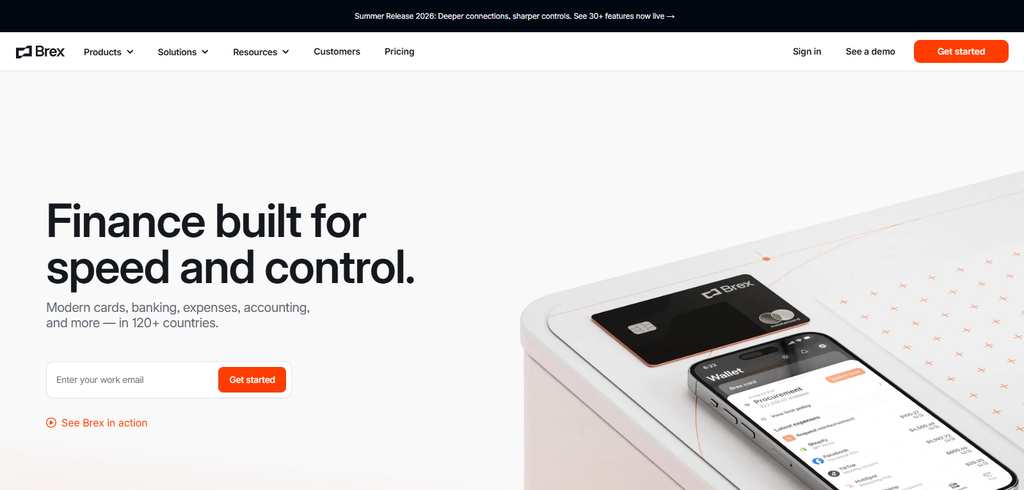
Business scalability is strong with Brex as they offer services for expense management, rewards, and integrations for startups. The local payment methods are U.S. centered, but Brex does allow spending outside the U.S. For tech startups in the U.S., Brex has very flexible underwriting, rewards targeted at the tech industry, and allows for rapid growth for operating a business without the constraints of banking.
Brex Details
- Started in 2017
- No account fees, revenue via interchange
- Instant settlement
- ACH and wire transfers supported
- Corporate credit cards with customized benefits
- Integrated expense management tools
- Flexible underwriting for startups
- Rapidly evolving and scalable financial technology
| Pros | Cons |
|---|---|
| No account fees | U.S.‑focused |
| Instant card settlements | ACH slower |
| Corporate rewards | Rewards tailored to tech |
| Flexible underwriting | Limited traditional banking |
| Expense management | Not ideal for freelancers |
| Startup‑friendly | Limited global reach |
| Scales quickly | No lending products |
| Strong integrations | Focused on enterprises |
9. Wise Business
Founded in 2011 and headquartered in the U.K., Wise Business (formerly TransferWise) focuses on low-cost international transfers. Wise charges around 0.35-1%, on average, for currency conversions. Settlement is fast, often same-day, and has multi-currency accounts for over 40 currencies.
Given the focus on transfer versus acquiring services, chargebacks are minimal. Wise Business’s solution allows SMEs to manage global payroll and vendor payments. With local payment options covering a majority of the business world, the solution is a natural fit for an international business. Wise’s solution is known for low prices and efficiency; it allows startups and SMEs to expand internationally without incurring hidden banking costs.
Wise Business Details
- Started in 2011
- FX fee transparency: 0.35% to 1%
- Multi-currency accounts with 40+ currencies
- Same day international settlements
- Payment rails for global payroll and vendor payments
- Minimal chargeback management
- Local payment rails globally
- Trusted for transparency and efficiency
| Pros | Cons |
|---|---|
| Transparent FX fees | No lending |
| Multi‑currency accounts | Limited chargeback |
| Same‑day transfers | Focused on transfers only |
| Global payroll | Premium features cost extra |
| Vendor payments | Limited SME tools |
| Local rails worldwide | No credit facilities |
| Trusted globally | Not full banking |
| Efficiency & transparency | Limited integrations |
10. Revolut Business
Founded in 2015 in the U.K., Revolut Business supports multi-currency accounts and financial solutions for SMEs. Pricing starts at zero for basic accounts; premium accounts start at £100 per month. Revolut Business offers fast settlement and especially quick transfers among Revolut accounts. Card settlement services feature chargeback management.
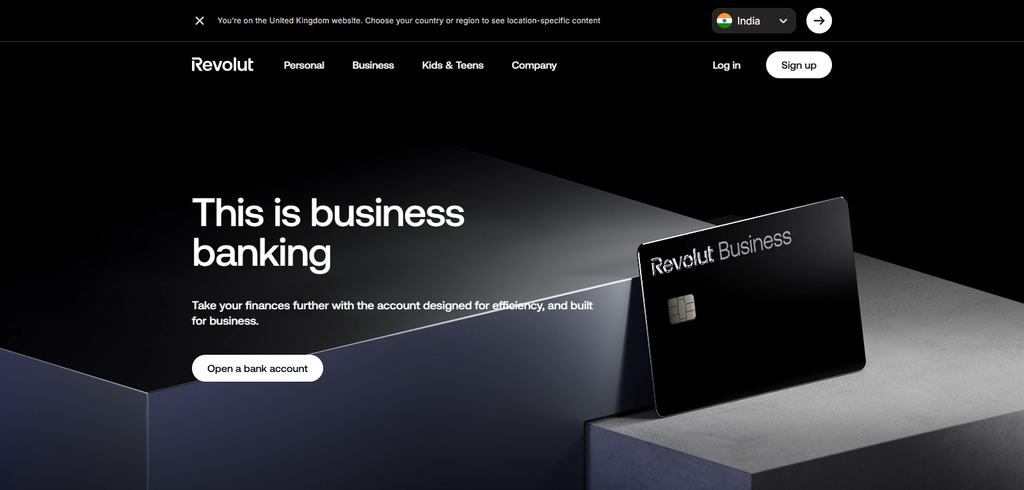
Business scalability is strong with integrations for payroll, expense management, and APIs. Local payment methods include SEPA, SWIFT, and domestic transfers. Revolut Business is ideal for SMEs for its pricing and efficiency, especially for managing international business affairs.
Revolut Business Details
- Started in 2015
- Tiered pricing from £0 to £100/month
- Multi‑currency accounts with SEPA and SWIFT payments
- Rapid domestic transfers
- Protection against chargebacks via cards
- Payroll and expense management tools
- API automation
- Scalable for SMEs and startups
| Pros | Cons |
|---|---|
| Free basic tier | Premium up to £100/month |
| Multi‑currency accounts | Limited outside Europe |
| Instant transfers | FX fees apply |
| Payroll tools | Customer support slow |
| API integrations | Add‑ons costly |
| Expense management | Not ideal for large firms |
| Transparent pricing | Limited lending |
| SME scalability | Focused on EU startups |
Conclusion
The modern business banking and fintech landscape includes options like Qonto, Airwallex, Payoneer, Novo, Starling Bank Business, RazorpayX, Mercury, Brex, Wise Business, and Revolut Business. Each option has its own strengths.
For example, European neobanks set themselves apart by robust transparent pricing structures and an emphasis on growing small to medium enterprises (SMEs). Global players typically focus on faster, low cost cross border payments.
Fintech companies in the U.S. often focus on innovation and startup friendly features. Innovation in local payment systems can be found in platforms like RazorpayX. As a whole, this global offering has changed the way freelancers, SMEs, and enterprises engage with digital banking by offering better pricing and faster, larger payment systems.
FAQ
What is Qonto best for?
Qonto is ideal for freelancers and SMEs in Europe, offering transparent monthly pricing, IBAN accounts, and accounting integrations.
How does Airwallex pricing work?
Airwallex charges FX margins of 0.3–0.6% above interbank rates, with no monthly account fees, making it cost‑effective for global payments.
Is Payoneer good for freelancers?
Yes, Payoneer is widely used by freelancers and marketplaces, with a $29.95 annual fee and fast settlement across 200+ countries.
Does Novo charge monthly fees?
No, Novo offers free ACH transfers, no monthly fees, and refunds ATM charges, making it startup‑friendly in the U.S.
What makes Starling Bank Business unique?
Starling offers free business accounts in the UK, instant Faster Payments, and optional add‑ons like bookkeeping tools.