


In this article, I cover the Best Sui RPC Providers with production in mind to aid developers in building Web3 applications that are fast, flexible, and dependable. Tailored for DeFi, gaming, and NFT applications, along with enterprise-level infrastructure
These RPC providers combine low-latency, high-availability, and secure blockchain connections. I will summarize their offer, examine their advantages, and assess their capability for production-level Sui projects in 2026.
What Are Sui RPC Providers?
Sui RPC providers let apps interface with the Sui blockchain in a number of ways. Thanks to managed RPC nodes, the Sui RPC providers make it easy to send transactions and access smart contract and blockchain data.
Since RPCs manage high-performance nodes, Response Time, Stability and Scalability are also managed. By 2026, production-grade Sui RPC providers will streamline the development of DeFi, Gaming, NFT, and other Web3 applications.

Why Businesses Need Reliable Sui RPC Providers In 2026
- Speed: Designed for rapid communication with Sui blockchain for low latency user experiences.
- High Demand: Efficient at meeting significant request volume for decentralized apps.
- Reduced Failures: Optimizes the reliability of Sui blockchain.
- Comprehensive Solutions: Fully accommodates the needs of evolving Web3 applications.
Key Points & Best Sui RPC providers for production in 2026
| Platform | Explanation |
|---|---|
| Chainstack | Supports multichain protocols with global nodes, DDoS protection, billing, archive nodes. |
| Dwellir | Provides enterprise gaming infrastructure with gRPC support and simple credit-based pricing. |
| QuickNode | Delivers fast DeFi performance using edge networks, analytics, and low latency. |
| Alchemy | Offers developer tools with monitoring, webhooks, documentation, and reliable APIs. |
| Blockdaemon | Provides institutional blockchain infrastructure with dedicated enterprise-grade compliance solutions. |
| dRPC | Routes requests across nodes, improving reliability, uptime, and decentralized performance. |
| GetBlock | Enables quick API integration with flexible endpoints and high throughput capabilities. |
| Infura | Connects Web3 applications through trusted infrastructure supporting popular blockchain ecosystems. |
| BlockPI | Uses decentralized nodes to deliver affordable, scalable, high-performance blockchain applications. |
| Allnodes | Helps developers deploy validators and self-hosted RPC clusters easily |
10 Best Sui RPC Providers for production in 2026
1. Chainstack
Chainstack is a leading blockchain infrastructure platform ideal for multipurpose developers. Chainstack is built to support multichain applications, protocols, and blockchain indexers. Chainstack provides access to global nodes that are guarded by enterprise DDoS protection.
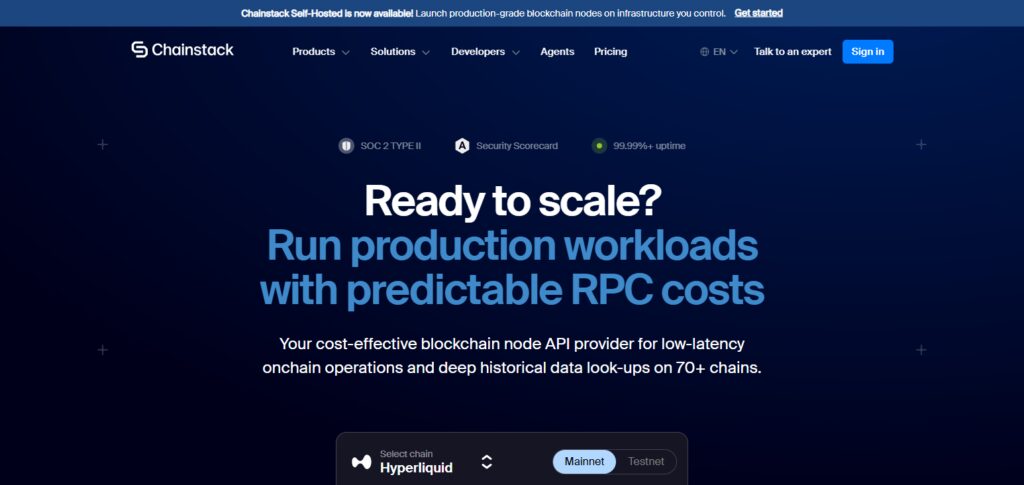
Because of this, Chainstack experiences stable performance in the face of heavy global traffic. Chainstack’s transparent and flexible pricing supports developers’ budgets in the absence of long-term contracts.
Because of Chainstack’s support for custom archive nodes, projects that need historical access to blockchain data are also great fits for Chainstack. Chainstack provides support for a variety of networks, scalable APIs, and developer tools. Chainstack remains an optimal choice for Web3 projects.
Chainstack Features
- Multichain Support: Developers can utilize scalable APIs to create applications on various blockchain networks. Chainstack provides the infrastructure.
- Global Secure Nodes: Chainstack has worldwide blockchain nodes that employ enterprise DDoS security.
- Custom Archive Nodes: Chainstack also offers custom nodes tailored to clients’ needs.
- Flexible Pricing Model: Chainstack uses a transparent pay-as-you-go billing approach without the costs of infrastructure or long-term contracts.
- Developer-Friendly Tools: Chainstack has robust APIs and monitors that facilitate Web3 development.
| Pros | Cons |
|---|---|
| Supports multiple blockchain networks for flexible multichain development. | Pricing can become expensive for high-volume applications. |
| Provides secure global nodes with DDoS protection features. | Advanced features may require technical blockchain knowledge. |
| Offers custom archive nodes for historical data requirements. | Limited focus on consumer-focused Web3 tools. |
| Transparent pay-as-you-go pricing improves budget control. | Some enterprise features require higher plans. |
2. Dwellir
Dwellir is a high tier blockchain infrastructure provider of enterprise applications, specifically targeting gaming and data focused Web3 applications. Dwellir supports the full gRPC protocol, allowing seamless and efficient communication between networks and applications.
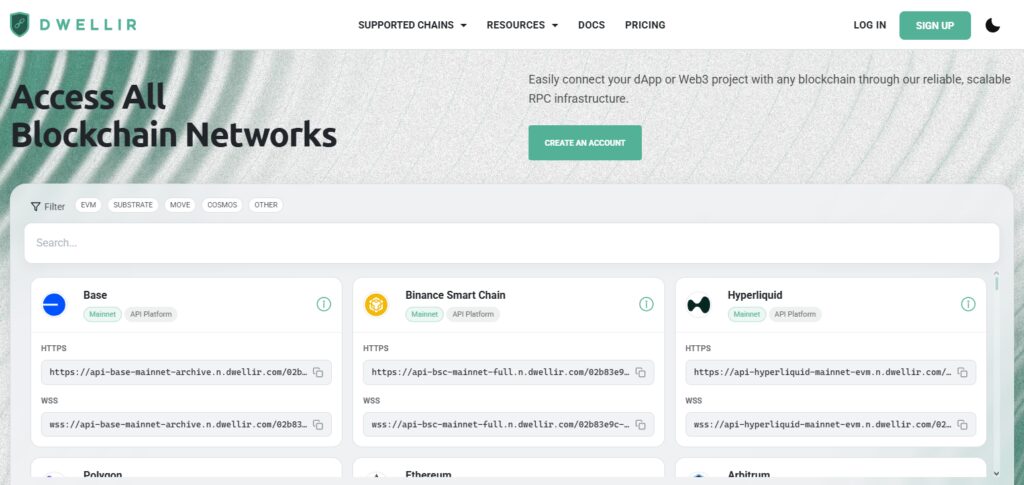
The transparent pricing of “1 request = 1 credit” eliminates billing complexity and provides developers with significant control over costs. Dwellir provides easy access to RPC, and scalable and high performance infrastructure that is optimal for high throughput.
Because of Dwellir’s focus on speed, enterprise reliability, and forecastable pricing, it is a great choice for enterprise blockchain based gaming and decentralized applications.
Dwellir Features
- gRPC Protocol Support: Dwellir offers enterprise-level performance with advanced gRPC communications. Blockchain interactions become faster.
- Simple Credit Billing: Dwellir employs a transparent billing system. Payers have control over costs.
- Performance Infrastructure: Dwellir employs advanced RPC with optimization for gaming and other Web3 applications.
- Enterprise Scalability: Performance and reliability of Dwellir’s network is consistent for large-scale projects.
- Fast Data Communication: Dwellir offers multiple solutions to expedite blockchain network communications.
| Pros | Cons |
|---|---|
| Provides high-performance infrastructure for enterprise applications. | Smaller ecosystem compared to major RPC providers. |
| Full gRPC support improves communication speed and efficiency. | Limited educational resources for beginners. |
| Simple credit-based billing makes costs predictable. | Network support may vary across blockchains. |
| Suitable for gaming and data-heavy Web3 platforms. | Less popular among small developers. |
3. QuickNode
QuickNode is a top blockchain infrastructure provider with an edge over its major rivals among DeFi app developers, trading app developers, and Web3 developers who require fast transaction processing. By applying its global edge network, it is able to offer low-latency RPC connections and performance enhancements.
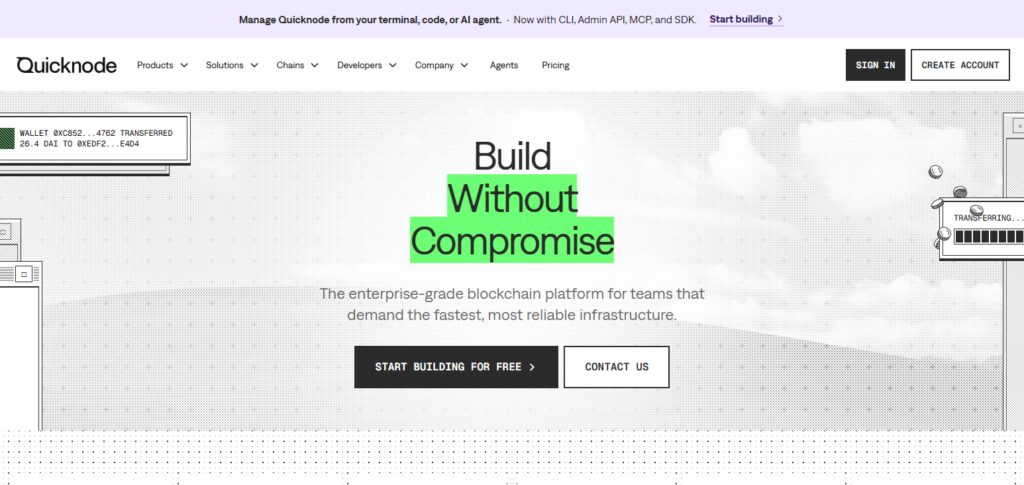
QuickNode offers advanced analytics dashboards, and real time monitoring among other developer tools. QuickNode manages apps on the blockchain. QuickNode has a wide range of networks on the blockchain and has the infrastructure to support small and large organizations.
Developers appreciate QuickNode’s focus on speed and reliability, as well as its advanced developer features. QuickNode is the best choice among its competitors for apps that require a blockchain workload that is large and complex.
QuickNode Features
- Global Edge Network: QuickNode provides low-latency communications with a globally dispersed network. Blockchain transactions are faster.
- Advanced Analytics Dashboard: QuickNode offers numerous real-time monitoring and performance tools.
- Multi-Chain Infrastructure: QuickNode’s offerings are diverse and support multiple blockchains.
- High Speed RPC Access: QuickNode supports high-volume transactions for DeFi and trading applications.
- Developer Tools: QuickNode has a large assortment of APIs and other resources to simplify the management of blockchain applications.
| Pros | Cons |
|---|---|
| Delivers low-latency RPC performance through global edge networks. | Premium features can increase operational costs. |
| Supports many blockchain networks and developer tools. | Advanced analytics may require learning time. |
| Provides monitoring dashboards for application performance tracking. | Free-tier limitations affect large-scale testing. |
| Ideal for DeFi and high-frequency transaction applications. | Heavy usage requires paid infrastructure plans. |
4. Alchemy
Alchemy is widely known for being an advanced blockchain developer platform among its competitors because of the Web3 development tools and infrastructures that it offers. Alchemy helps developers build scalable dApps by offering an advanced monitoring system, enhanced APIs, automated webhooks, and a comprehensive guide.
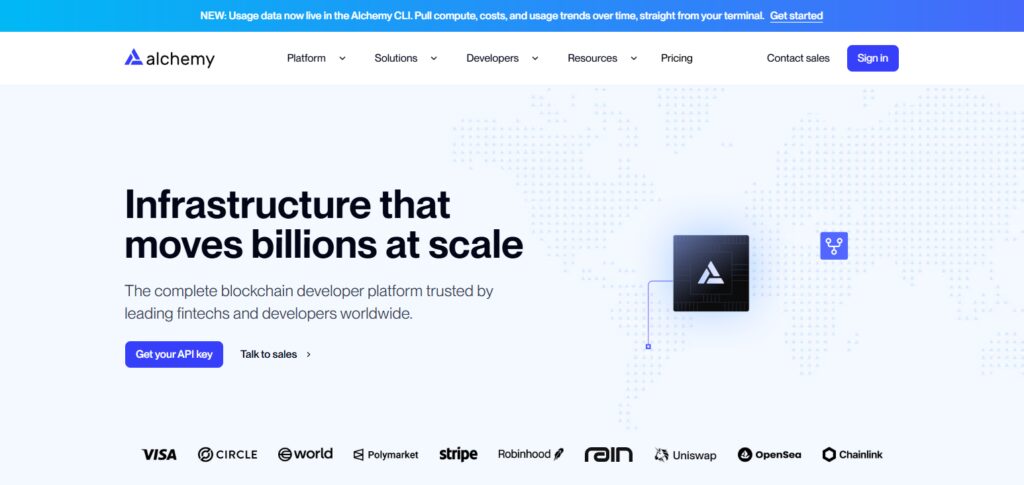
Alchemy’s features extend to many blockchains, and it provides developers with debugging tools, analytics, and a wide variety of educational resources. Alchemy supports an infrastructure that aims to support reliability in dApps by minimizing the effort needed for development.
Alchemy’s advanced developer support combined with its enterprise level features sustains its reputation among its competitors for developing commercial grade Web3 apps, NFT marketplaces, and decentralized frameworks.
Alchemy Features
- Developer Platform: Provides Web3 building blocks, APIs, and advanced infrastructure.
- Performance Monitoring: Developers can leverage real-time analytics and debugging to track the performance of their applications.
- Webhooks: Applications can be more responsive with instant notifications for blockchain events.
- Developer Guidance: Extensive guides and documentation for Web3 developers.
- Enterprise Ready: Commercial grade, secure, and scalable blockchain infrastructure.
| Pros | Cons |
|---|---|
| Offers powerful APIs, monitoring, and developer support tools. | Higher usage levels may become costly. |
| Provides extensive documentation and learning resources. | Mainly optimized for popular blockchain ecosystems. |
| Reliable infrastructure trusted by many Web3 developers. | Beginners may find advanced features complex. |
| Supports scalable decentralized application development. | Some features require premium subscriptions. |
5. Blockdaemon
Blockdaemon is a provider of enterprise grade blockchain infrastructure for institutional investors, large financial customers, and enterprise scale Web3 customers. Blockdaemon’s dedicated blockchain infrastructure is secure and compliant, and highly reliable.
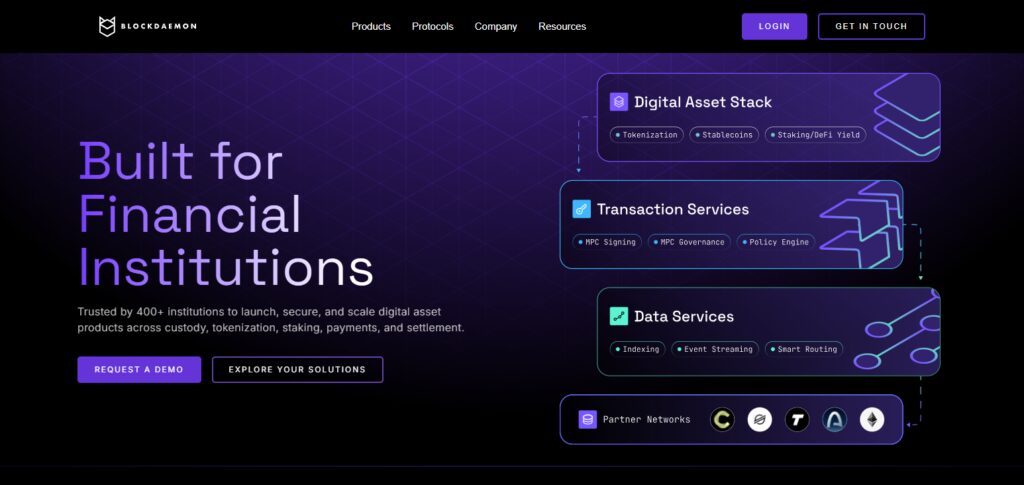
Blockdaemon supports staking and offers control of nodes, as well as management of validators and ease of connection to multiple blockchains. Blockdaemon’s solutions enable enterprises to control and secure their services and to meet their obligations while participating in blockchains.
Blockdaemon is used by enterprises that need secure and reliable infrastructure for critical operations with digital assets because it offers dedicated resources and institutional grade support and monitoring on its infrastructure.
Blockdaemon Features
- Enterprise Blockchain Infrastructure: Secure and reliable solutions for institutional operations.
- Custom Infrastructure: Dedicated nodes for organizations that need control and high performance.
- Validator Services: Staking, nodes, and blockchain validators made easy.
- Compliance Made Easy: Security and compliance requirements for enterprises are met.
- Advanced Institutional Monitoring: State-of-the-art monitoring for critical digital asset infrastructure.
| Pros | Cons |
|---|---|
| Provides enterprise-grade blockchain infrastructure and security. | Primarily designed for institutional users. |
| Supports staking, validators, and node management services. | Pricing details are less transparent publicly. |
| Helps organizations meet compliance requirements. | May be excessive for small projects. |
| Offers dedicated infrastructure with professional support. | Requires technical expertise for advanced operations. |
6. dRPC
dRPC is a decentralized infrastructure for RPC which helps disparate node providers fulfill requests in a more reliable way. Instead of relying on a single RPC provider, dRPC will route requests to numerous nodes, which will lessen downtime.
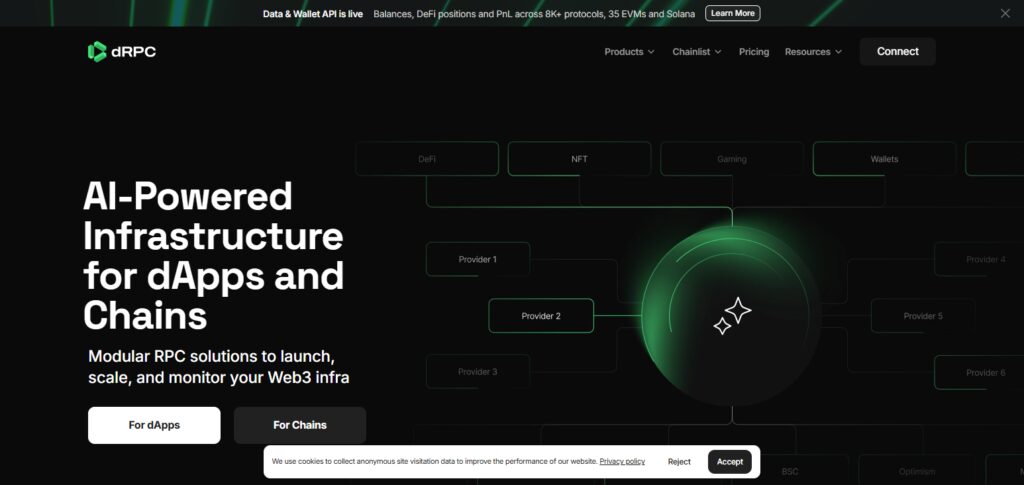
dRPC helps developers create decentralized applications that are highly available and performant, collectively addressing concerns of decentralized architecture, costs, and flexible connections to blockchains in a single solution.
dRPC Features
- Reliability & Performance: Distributes requests across several nodes.
- Decentralized Connectivity: Better availability by connecting to different node providers.
- Downtime Avoidance: Reduces failures by switching between independent systems.
- Flexible Access: Unlimited connections for decentralized apps and Web3 on scalable infrastructure.
- Cost Efficiency: Reduced infrastructure costs by optimal usage of resources.
| Pros | Cons |
|---|---|
| Uses decentralized routing for improved network reliability. | Relatively newer compared with established providers. |
| Reduces downtime through multiple node connections. | Limited brand recognition among enterprises. |
| Provides flexible RPC access for Web3 applications. | Documentation may need further expansion. |
| Helps reduce dependency on centralized infrastructure. | Advanced routing features require understanding. |
7. GetBlock
GetBlock provides developers with an efficient way to connect decentralized applications to blockchains. With both shared and dedicated endpoints, developers can build apps with flexible infrastructure. Fully dedicated blockchains mean high traffic apps can be served with no extra charge.
High throughput access is available for wallets, exchanges and DeFi apps, as well as the other Web3 apps. GetBlock is simple to use, and focuses on fast, scalable deployment. Because there are no blockchain nodes to maintain, GetBlock is ideal for developers looking to integrate an API quickly. The added simplicity helps teams develop with Web3 faster.
GetBlock Features
- Scalable Deployment: Simplifies infrastructure management, allowing Web3 teams to launch applications faster.
- Custom RPC Endpoints: Dedicated and shared endpoints.
- High Speed Access: Fast blockchain access for wallets, exchanges, and DeFi apps.
- Node Management Simplified: Easy API integration for developers and no need for managed blockchain nodes.
- Multi-Blockchain Support: Connects multiple blockchain networks.
| Pros | Cons |
|---|---|
| Enables quick blockchain API integration for developers. | Advanced enterprise features are limited. |
| Offers shared and dedicated RPC endpoints. | Less developer tooling compared with competitors. |
| Supports multiple blockchain networks efficiently. | Performance depends on selected endpoint type. |
| Provides scalable solutions for growing applications. | Pricing may increase with heavy usage. |
8. Infura
Infura has established itself as an important part of the blockchain infrastructure ecosystem. They connect Web3 applications to blockchains and offer RPC and API services. Infura has a wide range of scalable services and APIs that allow the building of decentralized applications, especially those that are Ethereum-centric.
Web3 integrates easily with Infura, allowing developers to build apps quickly and to access the blockchain without having to maintain their own nodes. The reliable nature of Infura, combined with extensive documentation and their established reputation, allows developers to build apps in confidence.
Infura Features
- Reliable RPC Services: Builds dependable infrastructure to connect Web3 applications to blockchain networking.
- Ethereum-Focused Support: Offers greater compatibility with Ethereum applications and ecosystems.
- Developer APIs: Provides scalable APIs for interacting with blockchain and sending transactions.
- Node-Free Development: Builds applications without the need for personal blockchain nodes.
- Extensive Documentation: Faster Web3 applications development aided by extensive documentation.
| Pros | Cons |
|---|---|
| One of the most trusted Web3 infrastructure providers. | Strongly associated with Ethereum-based applications. |
| Provides reliable RPC services and developer APIs. | High traffic applications may need premium plans. |
| Extensive documentation helps developers build faster. | Centralized infrastructure approach has limitations. |
| Widely integrated with popular Web3 tools. | Less flexible than decentralized RPC alternatives. |
9. BlockPI
BlockPI utilizes the decentralized architecture of blockchain nodes to offer RPC services that are faster, cheaper, and more scalable for Web3 applications, even those that are extremely high traffic.
BlockPI uses a combination of distributed network nodes and smart request management to offer a unique RPC solution that helps application developers meet the demand for their applications while incurring low costs.
BlockPI is geared toward projects like DeFi, gaming, and NFT that are popular among users and that access blockchain data. With the power of routing, decentralized technology, and scale, BlockPI helps developers of the Web3 ecosystem with blockchain data routing and connectivity.
BlockPI Features
- Decentralized Node Network: Distributed blockchain nodes build scalable RPC infrastructure.
- Smart Request Management: Routes blockchain data to improve application performance.
- High-Traffic Support: Efficiently workloads high-demand DeFi, gaming, and NFT applications.
- Cost-Efficient Infrastructure: Lowers operations costs with decentralized management of resources.
- Fast Blockchain Connectivity: Reliable and optimized access to blockchain networks.
| Pros | Cons |
|---|---|
| Provides decentralized architecture for better scalability. | Smaller market presence compared to leading providers. |
| Reduces costs through efficient node management. | Limited public resources for developers. |
| Suitable for high-traffic DeFi and gaming apps. | New users may require technical guidance. |
| Intelligent routing improves blockchain data access speed. | Blockchain network availability may vary. |
10. Allnodes
Allnodes is a blockchain infrastructure solution for smaller teams, developers, and validators that want an easier and simpler way to deploy and manage nodes. Allnodes allows users to deploy validators, manage blockchain nodes, and even self-host RPC clusters, including Sui support.
Because Allnodes is a managed infrastructure solution, many of the complicated and time-consuming parts of enterprise node management, such as hosting and monitoring, are eliminated. For teams looking to have reliable and managed blockchain operations without the complicated server environment, Allnodes fits the bill for emerging and cost-efficient blockchain operators.
Allnodes Features
- Simple Node Deployment: Simplifies the launching and managing of blockchain nodes.
- Validator Management: Simplifies the management of infrastructure for validator operations.
- Self-Hosted RPC Clusters: Customize the blockchain connectivity teams wish to build.
- Managed Infrastructure: Removes the technical challenges of hosting and monitoring by providing done-for-you services.
- Multi-Network Support: Supports emerging networks like Sui and other blockchain networks.
| Pros | Cons |
|---|---|
| Simplifies validator and node deployment processes. | Less suitable for large enterprise workloads. |
| Provides managed hosting with monitoring features. | Limited advanced developer APIs. |
| Supports self-hosted RPC cluster deployment. | Mainly focused on node operations. |
| Good option for smaller Web3 development teams. | Customization options may be limited. |
How We Chose Top Sui RPC Providers for Production
- Network Reliability: We took a closer look at reliability, uptime, and the consistency of blockchain connection.
- Speed Performance: We examined response times and latency and the efficiency of processed transactions.
- Sui Compatibility: We observed the support of Sui features, APIs, and integrations in the ecosystem.
- Developer Experience: We assessed the documentation and SDKs and their developer tools and ease of use.
- Pricing Flexibility: We accounted for reasonably priced plans, scalability, and corporate flexibility.
- Security Standards: We looked at protections of the infrastructure, secured nodes, and operational security.
Challenges of Sui RPC Infrastructure
- Network Demand Management: Achieving uniform performance amidst traffic and utilization spikes.
- High Demand Management: Handling excessive API requests without timeouts.
- RPC Model Selection: Making the decision to implement a centralized or decentralized model based on the requirements of the project.
- Cost Management: Building the infrastructure to support efficient scaling of the blockchain application while managing costs.
Future Trends of Sui RPC Providers in 2026
Latency will have a New Meaning: For rapid DeFi, gaming, and Web3 applications, RPC connections will have a new level of required speed.
AI Integrated Monitoring: Integration of AI will enhance observation of network behavior, the state of performance, and autonomous identification of errors.
Growth of Decentralized RPCs: More providers will utilize decentralized networks to improve reliability and transparency.
More Enterprises will Adopt Sui: More enterprises will rely on the Sui infrastructure for customizable and scalable Web3 solutions.
Smart Analytics: the performance of blockchain applications will be improved by smart analytics and automated scaling.
Conclusion
In conclusion, the most crucial consideration for production while building dependable, robust, and high-performance Web3 applications is the preference of the best Sui RPC providers. Sui RPC providers with exemplary uptime and response times, secure infrastructure combined with developer-friendly building blocks
will allow businesses to sustain and manage the increasing load on the Sui blockchain. In 2026, it will be possible for advanced Sui RPC solutions to provide DeFi, gaming, NFTs, and enterprise solutions with highly efficient and seamless connectivity to the Sui blockchain.
FAQ
Which Sui RPC provider is best for developers?
Chainstack, QuickNode, and Alchemy are popular choices for developer-friendly Sui infrastructure.
Are free Sui RPC endpoints suitable for production?
Free endpoints are useful for testing but paid solutions are better for production workloads.
What features should a Sui RPC provider offer?
Important features include low latency, security, scalability, monitoring, and API support.
Can Sui RPC providers handle high-traffic applications?
Yes, premium providers support large transaction volumes and scalable Web3 applications.
How do Sui RPC providers improve application performance?
They reduce latency, optimize requests, and provide stable blockchain connectivity.