
In the modern world, communication with privacy has become paramount for people across the globe. The Best Private Messaging Apps With End-to-End Encryption are no exceptions to this truth. The hacks, surveillance, and unauthorized access of the future will be no match for these apps’ protection over messages, calls, and files.
Digital and reliable communication are fully in each customer’s control. Encryption for the future will be strong enough to keep the personal conversations of users safe and private. Thus, they can rest assured digitally in the year 2026.
What is End-to-End Encryption (E2EE)?
End-to-End Encryption (E2EE) ensures that only the sender and intended recipient can see or access messages, calls, media, and files sent to one another. Data sent using E2EE is turned into an encoding of jumbled, unreadable, and meaningless characters.
Because of that, it is impossible for third parties to view the data, including hackers, ISPs, app companies, and streaming companies. The messaging app can also not view the data. This is because the keys to decipher the code are only on the users’ devices.
E2EE creates a digital tunnel that is locked on both ends. When using Signal, WhatsApp, iMessage, and other similar apps, messages leave the sending device only after being encrypted. The message can only be decrypted by the recipient’s device. As a result, private communications remain out of the reach of cybercriminals, app companies, and governments.
Key Point
| Private Messaging App | Key Security Features |
|---|---|
| Signal | Open-source protocol, default end-to-end encryption (E2EE), disappearing messages, minimal data collection |
| Default E2EE for chats & calls, biometric lock, encrypted backups | |
| Telegram | Secret Chats with E2EE, self-destruct timers, large group support |
| Threema | No phone number required, anonymous ID system, Swiss privacy laws |
| Session | Onion-routing network, no metadata storage, decentralized servers |
| Wire | E2EE messaging & conferencing, enterprise-grade security |
| Element | Decentralized Matrix protocol, E2EE rooms, self-hosting support |
| Viber | End-to-end encrypted chats & calls, hidden chats, spam protection |
| iMessage | Apple-device E2EE, secure FaceTime integration, device verification |
| Wickr Me | Military-grade encryption, message expiration, secure file sharing |
1. Signal
Signal is one of the best private messaging apps of 2026. You can securely chat, voice call, or video call other users through Signal with its incredibly strong end-to-end encryption that is on by default.
As the entire app is open-source, external security analysts can review the code for any privacy issues. Signal has earned trust worldwide through a lack of data collection and no message retention on their servers, especially from journalists, cybersecurity experts, and privacy advocates.
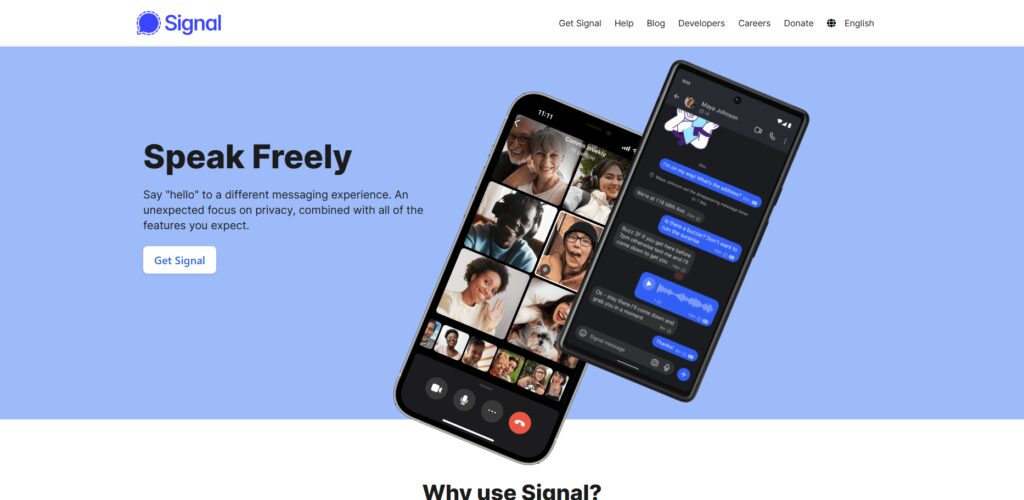
Signal has a simple, ad-less design and offers features such as disappearing messages, screen security, and encrypted backups.
It also has a registration lock. Signal has group chats, HD voice calls, large file sharing, and cross-platform syncing on Android, iPhone, Windows, macOS, and Linux. Signal’s strong encryption has led to other messaging apps using Signal’s technology to secure their communications.
| Category | Details |
|---|---|
| Founded | 2014 |
| Developer | Signal Foundation |
| Encryption | Default End-to-End Encryption |
| Encryption Protocol | Signal Protocol |
| Open Source | Yes |
| Phone Number Required | Yes |
| Metadata Collection | Extremely Minimal |
| Ads & Tracking | No Ads, No Tracking |
| Cloud Backup | Encrypted Backup Option |
| Best Feature | Maximum Privacy Protection |
| Privacy Level | Excellent |
| Disappearing Messages | Yes |
| Screen Security | Yes |
| Group Calls | Yes |
| File Sharing | Yes |
| Platforms | Android, iOS, Windows, macOS, Linux |
| Best For | Privacy-focused users, journalists, activists |
| Main Drawback | Smaller user base compared to WhatsApp |
2. WhatsApp
WhatsApp is one of the most widely used encrypted messaging apps with billions of active users in 2026. It offers end-to-end encryption for private chats, group chats, voice calls, video calls, and shared files by default. WhatsApp can only access messages when they use the Signal encryption protocol. This makes WhatsApp great for both personal and professional communication, as it is simple and has a huge user base.
WhatsApp promotes security by offering two-step verification, disappearing messages, an encrypted cloud backup, a biometric app lock, and multi-device capability. Sharing documents, photos, videos, and live locations is easy, as is conducting group video calls.
In spite of dealing with some problems of privacy because WhatsApp is owned by Meta and therefore does collect some metadata, WhatsApp is still the most secure messaging app that is suitable for everyday routine instant messaging as they keep amending the security controls.
| Category | Details |
|---|---|
| Founded | 2009 |
| Owner | Meta Platforms |
| Encryption | Default End-to-End Encryption |
| Encryption Protocol | Signal Protocol |
| Open Source | No |
| Phone Number Required | Yes |
| Metadata Collection | Moderate |
| Ads & Tracking | Some metadata tracking |
| Cloud Backup | Available |
| Best Feature | Massive Global User Base |
| Privacy Level | Good |
| Disappearing Messages | Yes |
| Voice & Video Calls | Yes |
| Multi-Device Support | Yes |
| Group Chats | Yes |
| Platforms | Android, iOS, Web, Desktop |
| Best For | Daily communication |
| Main Drawback | Meta data collection concerns |
3. Telegram
Combining privacy, speed, and messaging features, it is Telegram that has a lot of the messaging attributes defined. Because of the use of professional and secure encryption for communications with Secret Chats, Telegram has made the headlines with the use of self-destruct timers and screenshot protection. It has a lot of popularity among huge communities with the ability of Telegram to host huge groups and has a lot of admin controls.
One of the advantages of Telegram is the fast sharing of files, the multiple available Bots with data, and a lot of synchronization among the devices that one is using. Themes can also be customized. The chats are not end-to-end and thus need to be activated.
Despite this setback, Telegram is the messaging app of choice among those that are looking for privacy whilst looking for the extra attributes and functionality of professional communication.
| Category | Details |
|---|---|
| Founded | 2013 |
| Founder | Pavel Durov |
| Encryption | Secret Chats Only |
| Default E2EE | No |
| Cloud Storage | Yes |
| Open Source | Partially |
| Phone Number Required | Yes |
| Metadata Collection | Moderate |
| Best Feature | Large Groups & Channels |
| Privacy Level | Medium |
| Secret Chats | Yes |
| Self-Destruct Messages | Yes |
| File Sharing Limit | Very Large Files |
| Bots Support | Yes |
| Platforms | Android, iOS, Windows, macOS, Linux |
| Best For | Communities & large groups |
| Main Drawback | Regular chats not fully E2EE |
4. Threema
Coming from a country that has one of the most secure data policies, Threema is a messaging app that comes up as one of the best for privacy. Unlike many messaging apps, Threema does not require a phone number or an email for registration.
In order to aid the protection of their identity, users are given a random anonymous ID, which helps in reducing their exposure of private data. All messages, calls, private and group chats, and the files that are shared are protected using a strong end-to-end encryption.

This app is especially all about privacy and thus has a great no tracking policy which has to do with the infrastructure for the servers that are secured and thus is highly valued by the businesses and government organizations as well as those users that are privacy oriented.
Threema provides polls, file sharing, voice messages, video calls, and tools to securely communicate within an organization. Since most of the data is stored on a user’s device and not on a server, Threema provides superior privacy protection among the messaging apps of 2026.
| Category | Details |
|---|---|
| Founded | 2012 |
| Country | Switzerland |
| Encryption | Default End-to-End Encryption |
| Open Source | Yes |
| Phone Number Required | No |
| Anonymous ID System | Yes |
| Metadata Collection | Very Minimal |
| Ads & Tracking | No |
| Best Feature | Anonymous Registration |
| Privacy Level | Excellent |
| Secure Calls | Yes |
| Polls & Surveys | Yes |
| Business Version | Available |
| Cloud Backup | Limited |
| Platforms | Android, iOS, Web |
| Best For | Anonymous secure messaging |
| Main Drawback | Paid app |
5. c
Session is for users craving a highly anonymous and decentralized way of messaging. Unlike many messaging apps, Session doesn’t ask users for a mobile device number, for an email address, or for an account registration in a central place.
Session is based on a decentralized, modified Tor onion-routing protocol, which helps conceal users’ IP addresses and reduce the amount of metadata that is generated. Each of Session’s private communication messages is protected by end-to-end encryption.
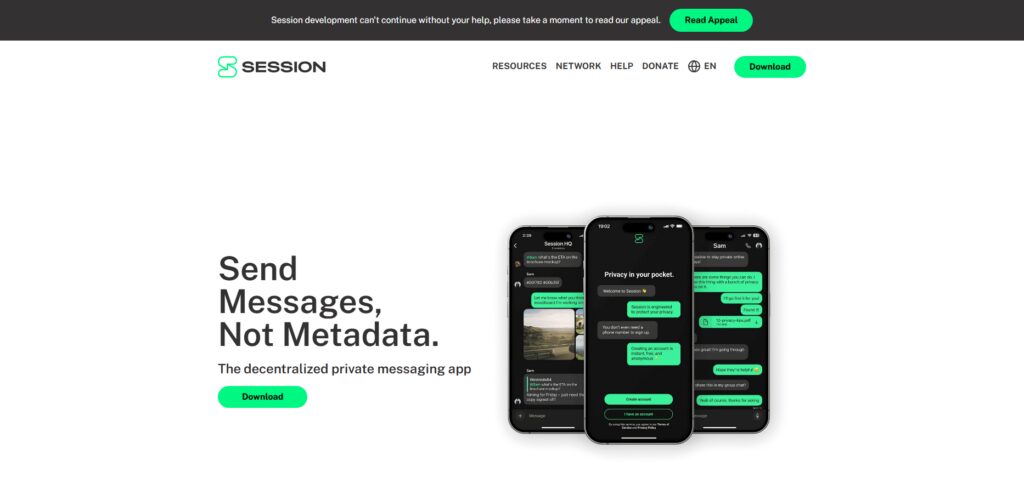
Session’s biggest benefits are that it is anonymous and censorship-resistant. Since Session is built on decentralized nodes, Session doesn’t have a central server to route messages. Thus it is built to be resistant against mass surveillance and data collection.
On all major operating systems, Session has support for encrypted group chats, voice messages, attachments, and messages that disappear. Because of the design of Session that is resistant to tracking, Session is popular for privacy activists and users in countries with heavy censorship.
| Category | Details |
|---|---|
| Founded | 2020 |
| Network Type | Decentralized |
| Encryption | Default End-to-End Encryption |
| Phone Number Required | No |
| Anonymous Signup | Yes |
| Open Source | Yes |
| Metadata Collection | Almost None |
| Onion Routing | Yes |
| Best Feature | Complete Anonymity |
| Privacy Level | Excellent |
| Decentralized Servers | Yes |
| Disappearing Messages | Yes |
| Group Chats | Yes |
| File Sharing | Yes |
| Platforms | Android, iOS, Windows, macOS, Linux |
| Best For | Anti-surveillance communication |
| Main Drawback | Slower message delivery sometimes |
6. Wire
Wire provides a highly secure way of communicating and is suitable for both individual and large firm use. Wire has end-to-end encrypted messaging and voice, video communication, and file sharing.
Wire being an open-source communication platform that operates compliant to the privacy regulations of Europe, is highly trusted for secure business communications. Wire fosters encrypted collaboration tools for organizations to secure their business conversations and the documents that are shared.
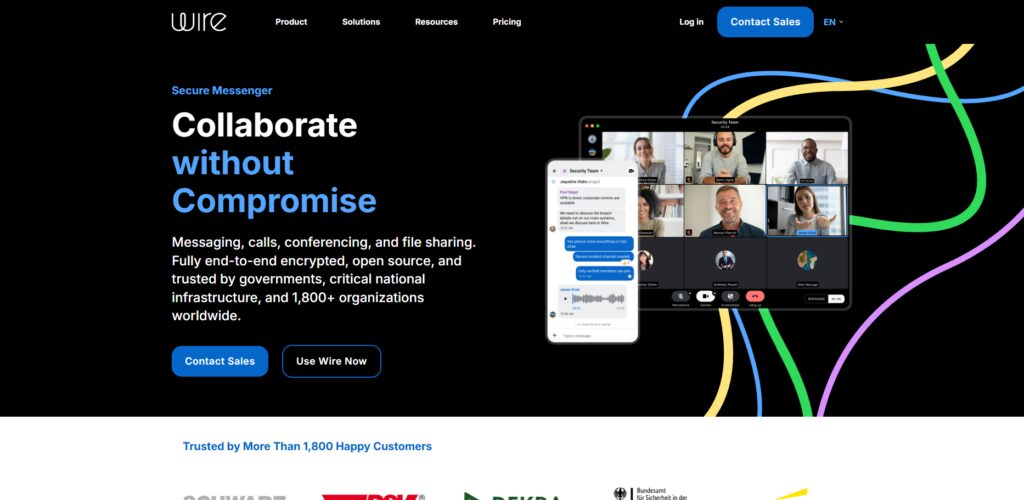
Wire has secure messaging solutions and then has features for guest rooms, secure team management, and protected conference calls, and then Wire has support for numerous devices and platforms that is synchronized.
Wire’s modern design and high level of security mean that it can be confidently used by any company, as well as by remote working teams. Advanced privacy controls are applied consistently while still offering mobile support on Android and iOS, desktop support on Windows, Mac OS, Linux, and all web browsers.
| Category | Details |
|---|---|
| Founded | 2014 |
| Country | Switzerland |
| Encryption | Default End-to-End Encryption |
| Open Source | Yes |
| Enterprise Support | Yes |
| Phone Number Required | Optional |
| Metadata Collection | Low |
| Best Feature | Secure Team Collaboration |
| Privacy Level | Very High |
| Video Conferencing | Yes |
| Secure File Sharing | Yes |
| Guest Rooms | Yes |
| Business Compliance | GDPR Compliant |
| Platforms | Android, iOS, Windows, macOS, Linux |
| Best For | Businesses & remote teams |
| Main Drawback | Smaller public user community |
7. Element
Element employs the open-source Matrix protocol to create a decentralized messaging platform. It does not rely on a singular, centralized corporation, and as such, offers secured communications through the use of end-to-end encryption. Element provides private collaborative rooms, voice messaging, and video conferencing.
The protocol Matrix is established on the principle of decentralization and thus allows the user to utilize self-hosting. This, in turn, guarantees the user greater control and ownership of the data.
Furthermore, because of its unique offerings, Element continues to become increasingly popular amongst developers, privacy advocates, enterprises, and large government organizations. Finally, the platform’s open-source structure and modular design create an extensive, flexible messaging platform in 2026.
| Category | Details |
|---|---|
| Founded | 2017 |
| Protocol | Matrix Protocol |
| Encryption | End-to-End Encryption |
| Open Source | Yes |
| Decentralized | Yes |
| Self Hosting | Supported |
| Phone Number Required | No |
| Metadata Collection | Minimal |
| Best Feature | Full Decentralization |
| Privacy Level | Excellent |
| Group Collaboration | Yes |
| Voice & Video Calls | Yes |
| Cross-Platform Sync | Yes |
| Government Usage | Yes |
| Platforms | Android, iOS, Windows, macOS, Linux |
| Best For | Developers & organizations |
| Main Drawback | Complex for beginners |
8. Viber
As a messaging and calling platform, Viber utilizes end-to-end encryption to secure communications. It creates private chats, group messaging, and voice or video calling. The platform automatically utilizes encryption technology to safeguard communications and also provides hidden chats, spam protection, and a messages control feature.
This app focuses on strong privacy and provides features to improve communication for the users. This messaging and calling application also provides HD-quality messaging and calls, the ability to share media, group communities, Welch a sd stickers, and a synchronization feature across all devices, including computers and mobile devices. Furthermore, the user can hide chats by setting a lock and can use disappearing messages.
Although Viber may not prioritize anonymity the way Signal or Session do, the app still has encrypted communications that millions of users depend on in 2026.
| Category | Details |
|---|---|
| Founded | 2010 |
| Owner | Rakuten |
| Encryption | Default End-to-End Encryption |
| Open Source | No |
| Phone Number Required | Yes |
| Metadata Collection | Moderate |
| Hidden Chats | Yes |
| Best Feature | Secure Everyday Communication |
| Privacy Level | Good |
| Voice & Video Calls | Yes |
| Group Communities | Yes |
| Sticker Support | Yes |
| Multi-Device Sync | Yes |
| Spam Protection | Yes |
| Platforms | Android, iOS, Windows, macOS |
| Best For | Personal communication |
| Main Drawback | Less privacy transparency |
9. iMessage
iMessage is Apple’s security-integrated messaging system that comes built in on every iPhone, iPad, Mac, and other Apple products. In 2026 iMessage provides end-to-end encryption for messages, media, and FaceTime calls for all Apple users.
Apple’s closed ecosystem helps maintain device level security through Biometric authentication, secure hardware encryption, and account verification protections.

Sufficiently rich communication is supported, including media, reactions, stickers, and group chats, as well as conversation synchronization across Apple devices.
Advanced security measures, such as Lockdown Mode, advanced account protection, and encrypted iCloud backups, improve user privacy. iMessage’s encryption works only within the Apple ecosystem, which also restricts it to Apple hardware and peripherals, and fails to work for Android users.
| Category | Details |
|---|---|
| Released | 2011 |
| Owner | Apple |
| Encryption | Default End-to-End Encryption |
| Ecosystem | Apple Only |
| Open Source | No |
| Phone Number Required | Yes |
| Metadata Collection | Low |
| Best Feature | Deep Apple Integration |
| Privacy Level | Very High |
| FaceTime Integration | Yes |
| iCloud Sync | Yes |
| Device Verification | Yes |
| Secure Hardware Protection | Yes |
| Platforms | iPhone, iPad, Mac |
| Best For | Apple users |
| Main Drawback | Not available on Android |
10. Wickr Me
Wickr Me is a messaging app that helps people achieve professional privacy and seamless secure communications. The app is best known for its use of end-to-end secure messaging and cryptography. Users benefit from controls that help create a secure communicative atmosphere.
Examples of these controls include message expiration timers, screenshot detection, and permanent, secure message deletion. The app further supports secure conversations for complicated topics and provides collaboration tools for message exchanges.
Wickr Me is especially useful for businesspeople, journalists, and cyber security operatives dealing with professional, classifiable information.
The app makes secure group communications a reality while curtailing the amount of information that is inappropriately collected and/or communicated. Available upon most consumer information technology (IT) platforms, Wickr is one of the most secure messaging apps catering to the private and professional communication needs of users in 2026.
| Category | Details |
|---|---|
| Founded | 2012 |
| Owner | Amazon AWS |
| Encryption | Military-Grade End-to-End Encryption |
| Open Source | Partial |
| Phone Number Required | No |
| Metadata Collection | Very Minimal |
| Best Feature | Secure Professional Communication |
| Privacy Level | Excellent |
| Self-Destruct Messages | Yes |
| Screenshot Detection | Yes |
| Secure File Sharing | Yes |
| Voice & Video Calls | Yes |
| Team Collaboration | Yes |
| Platforms | Android, iOS, Windows, macOS |
| Best For | Professionals & confidential communication |
| Main Drawback | Smaller mainstream adoption |
Why Private Messaging Apps Matter in 2026
Protection from Cyber Threats
End-to-End encryption strengthens apps to help users defend themself against hackers, phishing attempts, malware, and even breaches. This applies to the chats, calls, and files shared throughout the app.
Increasing Online Privacy Issues
By 2026, with the growth of data collection and online breaches, many people will use secure apps for messaging to keep their personal privacy.
Secured Personal/Business Communication
People send a lot of highly sensitive personal information, like financial data and business documents, over messaging apps. There is a clear need for stronger security measures for messaging.
Prevention of Unauthorized Access
Encrypted messaging apps ensure that the sender and receiver only have the ability to read the conversations, also making them virtually impossible to be accessed by other parties, companies, or attackers.
Indefinite Communication Demand
Anonymous communication apps like Session and Threema offer communication with apps that require literally no information about the users.
Calls and Video Conferences
Private messaging apps contain voice calls and video conferencing, along with sharing other media, all protected by advanced encryption technologies.
Control of Personal Information
Signal is an app that gathers almost no information from its users and provides the users with almost complete control of their information and the conversations within the app.
Key Features to Look for in a Secure Messaging App
Default E2EE
Unless you’ve been living under a rock, you probably understand that a truly secure messaging app will have E2EE set by default, meaning nobody except the sender and the recipient are able to see messages, calls, and shared files.
Minimal Data and Metadata Collection
The goal of privacy-focused apps is to reduce the threat of tracking and surveillance to the fullest extent possible. Achieving that goal requires collecting almost no personal data, browsing activity, and communication meta data.
Open-Source Security Transparency
Messaging apps that use E2EE can publish their source code, which independent security experts can use to check whether the platform achieves its stated privacy and E2EE claims, confirming their privacy and security policies.
Disappearing Messages and Self-Destruct Timers
More privacy protection is enabled by apps that have disappearing messages that delete conversations after a specified time.
Secure Voice, Video Calls, and Media
To ensure security, private messaging apps should encrypt all voice and video calls, along with all media.
Multi-Device Support with Secure Syncing
The most effective messaging apps can securely sync chats across smartphones, tablets, and desktop devices while maintaining optimal encryption and privacy.
Strong Account Protection Features
Offering essential tools (such as 2FA, biometric lock, screenshot protection, and encrypted backups) will help ensure that the messaging app maintains high levels of security for both the app and its users.
Common Privacy Risks in Messaging Apps
Metadata Collection
Even if your messages are encrypted, your message app still collects metadata like your contact lists, your ip address, your device specs, and even how you interact with others.
Weak or Optional Encryption
Some apps may not have strong end-to-end encryption (e2ee) built in by default, messages may be accessible by hackers, companies, or may be exposed to third parties.
Cloud Backup Vulnerabilities
Cloud storage backups of messages and media may be left unencrypted, and therefore may be exposed by unauthorized access and leaks.
Phishing & Social Engineering Attacks
Criminals may use messaging services to provide a fake link, or a SCAM, or may even be impersonating someone else, and may attempt to steal your personal information and password by tricking you.
SIM Swapping Attacks
A service may be vulnerable when a criminal uses a SIM Swapping attack and gains access to your phone number.
Third Party Data Sharing
Your messaging app privacy is diminished when your data and your interactions are sold to other companies and advertisers.
Malware & Spyware Risks
When you download a file, or click on an unknown link, or when you modify your messaging app, your device may become infected with spy software, tracking software, or malware.
Conclusion
In 2026, end-to-end encryption messaging apps have become a necessity to combat privacy concerns and digital threats, particularly the need for safe messaging. Signal, WhatsApp, Telegram, Threema, and Session, are examples of the rising apps and how users want better protection for their private and work-related conversations.
From the data, it is obvious that differentiating privacy among messaging apps is possible. There are apps that have default end-to-end encryption, and very little to no data collection, and there are apps that have some level of encryption, and mostly, some of them use a cloud-based messaging system, which is a big difference.
Accordingly, it is up to the users to decide which app suits their requirements, concerns, and objectives, whether that is the convenience of messaging apps for their work and/or personal use, or privacy and protection for business-related communication.
As a result, the future of messaging will be privacy, encryption, and control. The threats to digital communications will only increase; thus, secure messaging apps will be crucial to providing safe and private communication and reliable connections to users everywhere.
FAQ
What is the safest private messaging app in 2026?
The safest messaging apps are those with default end-to-end encryption and minimal data collection. Apps like Signal and Session are considered top choices due to strong privacy, no ads, and very limited metadata tracking.
Is WhatsApp fully end-to-end encrypted?
Yes, WhatsApp uses end-to-end encryption for chats, calls, and media by default. However, it still collects some metadata, which is a key difference compared to more privacy-focused apps.
Is Telegram completely private and encrypted?
No, Telegram is not fully end-to-end encrypted by default. Only “Secret Chats” use E2EE, while normal chats are stored in the cloud for faster syncing across devices.
Which messaging app does not require a phone number?
Apps like Threema and Session allow users to communicate without using a phone number, offering better anonymity and privacy.
Are encrypted messaging apps 100% safe?
No app is 100% safe. Even with end-to-end encryption, risks like phishing, malware, and device hacking can still affect users. However, apps like Signal significantly reduce communication-level risks.